The Business Case for Standardized Buildings in Uncertain Markets

Standardized building business strategies are gaining traction as developers and investors face increasingly unpredictable market conditions. Material price volatility, labor shortages, and shifting demand cycles have made traditional custom-built approaches harder to manage. In this environment, companies are looking for ways to reduce uncertainty without sacrificing scalability. Standardization offers a practical solution by turning building design into a repeatable, controllable process rather than a one-time effort.
Instead of starting from zero for every project, standardized systems allow teams to reuse proven designs, optimize procurement, and shorten execution timelines. The result is not only faster delivery, but also more reliable outcomes in terms of cost and quality.
Why Standardization Is Gaining Attention in Volatile Markets
Market uncertainty affects every stage of a construction project. Prices for steel, concrete, and equipment can change within months, while supply chain disruptions can delay critical components. At the same time, developers are under pressure to deliver projects quickly to meet demand.
In this context, the standardized building business model reduces exposure to unpredictable variables. By relying on repeatable systems, companies can plan material usage more accurately and avoid redesigning structures every time market conditions change.
There is also a shift in how developers evaluate risk. Instead of focusing only on initial cost, they are paying more attention to execution certainty. A slightly higher upfront investment in standardized systems can result in lower total risk, especially when timelines are tight.
What “Standardized Buildings” Actually Mean
Standardized buildings are often misunderstood as identical structures repeated without variation. In reality, standardization focuses on creating a flexible system that can be adapted to different projects while maintaining a consistent core design.
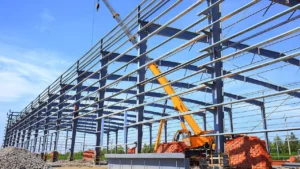
At the center of this approach are repeatable elements such as structural grids, connection details, and modular layouts. These components allow engineers to design buildings more efficiently while still adjusting dimensions and configurations based on project requirements.
Modular planning plays a key role here. Instead of designing a building as a single continuous structure, it is divided into smaller units that can be combined in different ways. This makes it easier to scale projects up or down without changing the entire design.
It is also important to distinguish between modular planning and prefabrication. While prefabrication focuses on manufacturing components off-site, modular planning is about organizing the design in a way that supports repetition. The two concepts often work together, but they are not the same.
How Standardization Improves Cost Control
Cost control is one of the strongest arguments for adopting a standardized building business approach. When designs are repeated, material quantities become more predictable, which allows companies to negotiate better prices with suppliers.
Bulk procurement is easier when the same components are used across multiple projects. Instead of purchasing materials in small quantities for each job, developers can secure long-term agreements that reduce price fluctuations.
Design costs also decrease because engineers spend less time creating new drawings. Once a system is developed, it can be reused with minor adjustments, reducing both effort and risk of error.
Another important factor is the reduction of change orders during construction. When a design has already been tested in previous projects, there are fewer unexpected issues on site. This leads to more stable budgets and fewer delays.
Speed as a Competitive Advantage
In uncertain markets, speed is often more valuable than cost savings alone. Projects that reach completion earlier can start generating revenue sooner, which improves overall returns.
The standardized building business model supports faster execution by simplifying both design and construction processes. Because the system is already defined, engineers can complete drawings more quickly, and contractors can begin work with fewer uncertainties.
Standardization also enables parallel workflows. While one part of the project is being finalized, another part can already move into fabrication. This overlap reduces the total project duration and allows companies to respond faster to market opportunities.
Approval processes may also become more efficient when standardized designs are used. Authorities are often familiar with proven systems, which can simplify the review process. This contributes to shorter timelines, especially in regions with complex permitting requirements.
Modular Planning and Its Role in Risk Reduction
Modular planning helps break large projects into smaller, manageable units. This approach reduces complexity and makes it easier to coordinate different stages of construction.
Instead of managing a single large structure, teams can focus on individual modules that follow the same design logic. This improves scheduling and allows work to progress in parallel.
- Smaller units reduce coordination challenges between teams
- Repetition allows faster problem solving when issues occur
- Phased construction becomes easier to manage
- Changes can be applied to specific modules without redesigning the entire project
By reducing complexity, modular planning supports better risk management. Even if one part of the project faces delays, other sections can continue moving forward.
Repeatable Design and Operational Efficiency
Repeatable design is at the core of standardization. Once a system has been tested and refined, it can be applied across multiple projects with consistent results.
This approach creates a feedback loop where each project improves the next one. Lessons learned from previous construction phases can be incorporated immediately, reducing errors and improving efficiency.
Operational efficiency also increases because teams become familiar with the system. Contractors, engineers, and suppliers can develop standardized workflows, which reduces learning time and improves productivity.
For companies managing multiple projects at the same time, this consistency is especially valuable. Instead of adapting to a new design for each project, teams can focus on execution using a familiar system.
Standardized vs Custom Building Approach
| Factor | Standardized Approach | Custom Approach |
|---|---|---|
| Cost Predictability | High, due to repeatable components | Low, varies by project |
| Timeline Reliability | More consistent schedules | Higher risk of delays |
| Design Flexibility | Moderate, within system limits | High, but less efficient |
| Risk Exposure | Lower due to proven systems | Higher due to unique design |
| Scalability | Easy to replicate | Difficult to scale |
The comparison shows that standardization does not eliminate flexibility, but it balances it with efficiency. Companies that adopt this model often achieve more stable results across multiple projects.
Industries That Benefit Most from Standardized Building Business
Certain industries are particularly well suited to the standardized building business approach. These sectors often require multiple facilities with similar functions, making repetition both practical and beneficial.
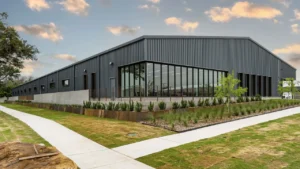
Logistics and warehouse development is one of the clearest examples. Distribution centers typically follow similar layouts, which makes it easy to apply repeatable design principles. Standardization allows developers to expand quickly across different locations.
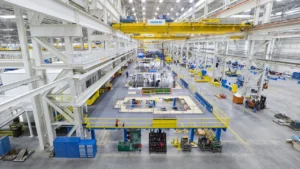
Manufacturing facilities also benefit from this approach. While equipment layouts may vary, the structural systems can often be standardized, reducing design time and improving construction efficiency.
Data centers, retail chains, and industrial parks are other sectors where standardized systems are commonly used. In each case, the ability to replicate a proven design provides a strong advantage in uncertain markets.
Supply Chain Advantages of Standardization
One of the less visible but highly impactful benefits of a standardized building business approach lies in supply chain optimization. When projects rely on repeatable components, procurement becomes more predictable and easier to manage over time.
Instead of sourcing different materials for every project, companies can build long-term relationships with selected suppliers. This reduces negotiation time and improves pricing stability, especially in markets where material costs fluctuate frequently.
Some practical advantages include:
- Pre-qualified suppliers familiar with the same specifications
- Reduced lead time due to repeated orders of similar components
- Better inventory planning across multiple projects
- Lower risk of sourcing errors or incompatible materials
In volatile markets, this level of consistency can significantly improve execution reliability. When supply chains are aligned with standardized designs, disruptions are easier to manage because alternative suppliers can follow the same specifications.
When Standardization Does Not Work Well
Despite its advantages, standardization is not suitable for every project. Some developments require unique architectural solutions or highly customized structures that cannot be easily replicated.
Landmark buildings, for example, often prioritize design identity over efficiency. These projects involve complex geometries and unique materials, which limit the application of repeatable systems. In such cases, a fully standardized approach may reduce design flexibility too much.
Urban constraints can also limit standardization. Projects in dense city environments may need to adapt to irregular site conditions, existing infrastructure, or strict zoning regulations. These factors can make it difficult to apply a fixed structural grid or modular layout.
There is also a risk of over-standardization. If companies rely too heavily on one system, they may lose the ability to adapt when market requirements change. This is why most successful developers balance standardization with selective customization.
Why Investors Prefer Standardized Building Strategies
From an investment perspective, predictability is often more valuable than maximum theoretical returns. The standardized building business model offers a level of certainty that is difficult to achieve with fully customized projects.
Investors are particularly interested in three factors:
- Cost stability: budgets are easier to estimate and control
- Timeline reliability: projects are less likely to face unexpected delays
- Scalability: successful designs can be repeated in multiple locations
These characteristics make standardized projects easier to finance. Lenders are more comfortable supporting developments with predictable outcomes, which can reduce financing costs and accelerate project approval.
In uncertain markets, where demand may shift quickly, the ability to deploy capital efficiently becomes a key advantage. Standardization allows investors to move faster while maintaining control over risk.
Standardized Building Business and Market Expansion
Standardization also supports expansion into new markets. When a company has a proven building system, it can replicate the same approach in different regions with minimal adjustments.
This reduces the learning curve associated with entering a new market. Instead of developing a completely new design, teams can adapt existing systems to local conditions. This approach saves time and reduces uncertainty during the early stages of a project.
Consistency is another benefit. When the same design principles are used across multiple locations, quality control becomes easier. This is particularly important for companies that operate internationally and need to maintain a consistent standard across all facilities.
The standardized building business approach therefore supports both growth and stability. It allows companies to expand while maintaining control over execution.
Future Outlook: Standardization as a Default Strategy
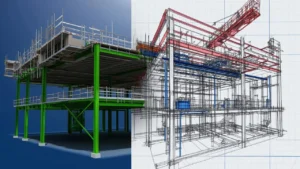
The role of standardization in construction is expected to grow as digital tools and manufacturing processes continue to evolve. Technologies such as parametric design and automation make it easier to develop flexible systems that can be reused across different projects.
At the same time, the integration of prefabrication and modular construction is strengthening the case for standardization. When components are produced in controlled environments, consistency improves and construction timelines become more predictable.
According to industry research from McKinsey on modular construction, standardized and product-based building approaches can significantly reduce project timelines and improve cost efficiency. These findings support the idea that repeatable systems are becoming a central strategy in modern construction.
Looking ahead, the combination of modular planning, digital design systems, and advanced supply chain management will likely make standardization even more effective. Companies that adopt these methods early may gain a competitive advantage in markets where speed and reliability are critical.
However, the future is not about choosing between standardization and flexibility. The most successful strategies will combine both, using standardized systems as a foundation while allowing targeted customization where necessary.
In uncertain markets, this balanced approach provides a practical path forward. By reducing risk, improving efficiency, and supporting scalable growth, the standardized building business model is likely to remain a key part of industrial and commercial development strategies in the years ahead.