How to Reduce Waste in Steel Fabrication With Smarter Nesting
Material cost represents a large portion of total expense in steel fabrication. Even small improvements in cutting efficiency can significantly increase profit margins. Because of this, many fabrication shops focus on steel nesting to reduce waste as a key production strategy rather than just a programming task.
By improving material utilization, optimizing CNC cutting, and tracking yield improvement, fabricators can reduce scrap, lower purchasing cost, and increase overall production efficiency. Smarter nesting is not only about software—it requires coordination between engineering, planning, and shop operations.
Why Material Waste Is a Major Cost in Steel Fabrication
In most fabrication projects, raw steel is one of the largest cost components. Plates, beams, and profiles are purchased in standard sizes, but project parts rarely match those dimensions exactly. Without proper planning, unused material quickly becomes scrap.
Common causes of high waste include:
- Poor cutting layout
- Incorrect plate size selection
- Manual nesting without optimization
- Late design changes
Implementing steel nesting to reduce waste allows fabricators to plan cutting patterns before production starts, ensuring that each plate or section is used as efficiently as possible.
What Is Steel Nesting in Fabrication
Nesting is the process of arranging parts on raw material to minimize unused space. In steel fabrication, nesting determines how plates, sheets, or structural sections are cut to produce the required components.
Modern nesting is usually performed using specialized software that calculates the most efficient layout. Instead of manually placing parts, the system automatically finds the arrangement that produces the highest material utilization.
Nesting applies to:
- Plate cutting
- Sheet cutting
- Beam and section cutting
- Pipe cutting
When done correctly, steel nesting to reduce waste can significantly lower the total material required for a project.
How CNC Cutting Enables Better Nesting
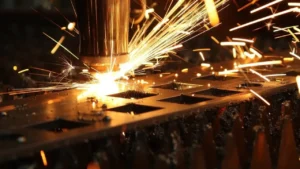
Modern fabrication shops rely on automated cutting machines to achieve precise results. Technologies such as plasma, laser, and oxy‑fuel cutting allow parts to be produced exactly according to the nesting layout.
With accurate CNC cutting, fabricators can:
- Place parts closer together
- Reduce cutting gaps
- Follow complex nesting patterns
- Repeat layouts consistently
Without CNC equipment, complex nesting layouts would be difficult to execute. This is why steel nesting to reduce waste is closely connected to automated cutting systems.
Material Utilization vs Scrap Rate
Fabrication efficiency is often measured by utilization rate. This percentage shows how much of the purchased material becomes usable parts.
For example:
- 90% utilization → very efficient
- 80% utilization → acceptable
- 70% utilization → high waste
Improving utilization by only a few percent can produce large savings on big projects. This is why shops track yield improvement as a key performance indicator.
Using steel nesting to reduce waste helps increase utilization by optimizing how parts are arranged before cutting begins.
Nesting Strategy for Plates vs Sections
Different types of material require different nesting methods. Plates and structural sections cannot be optimized in the same way.
For plates, nesting focuses on layout efficiency:
- Rotating parts to fit better
- Using common cut lines
- Grouping similar thickness parts
For beams and sections, nesting focuses on length optimization:
- Cutting multiple parts from one length
- Tracking remaining pieces
- Reusing remnants in future jobs
Combining these methods allows consistent yield improvement across different types of fabrication work.
Yield Improvement Through Software Optimization
Modern nesting software can automatically calculate thousands of layout possibilities in seconds. This allows fabricators to find the best cutting pattern without manual trial and error.
Advanced nesting systems support:
- Automatic layout generation
- Remnant tracking
- Database of available material
- Simulation before cutting
By using software tools together with CNC cutting, shops can consistently apply steel nesting to reduce waste and maintain high efficiency across multiple projects.