How to Choose the Right Building Bay Spacing for Factories
When planning a new industrial facility, most owners focus on total building area, equipment investment, and production capacity. However, one structural decision quietly influences all three: factory bay spacing design. The distance between columns—often referred to as bay spacing—determines not only structural performance but also long-term operational efficiency, construction cost, and expansion flexibility.
Choosing the right bay spacing is not just an engineering calculation. It is a strategic decision that affects span economics, workflow, foundation cost, and equipment layout. A poorly planned column grid can disrupt production lines, increase steel consumption, and limit future growth. A well-optimized grid, on the other hand, balances structural efficiency with operational flow, creating a factory that performs effectively for decades.
Understanding Factory Bay Spacing Design
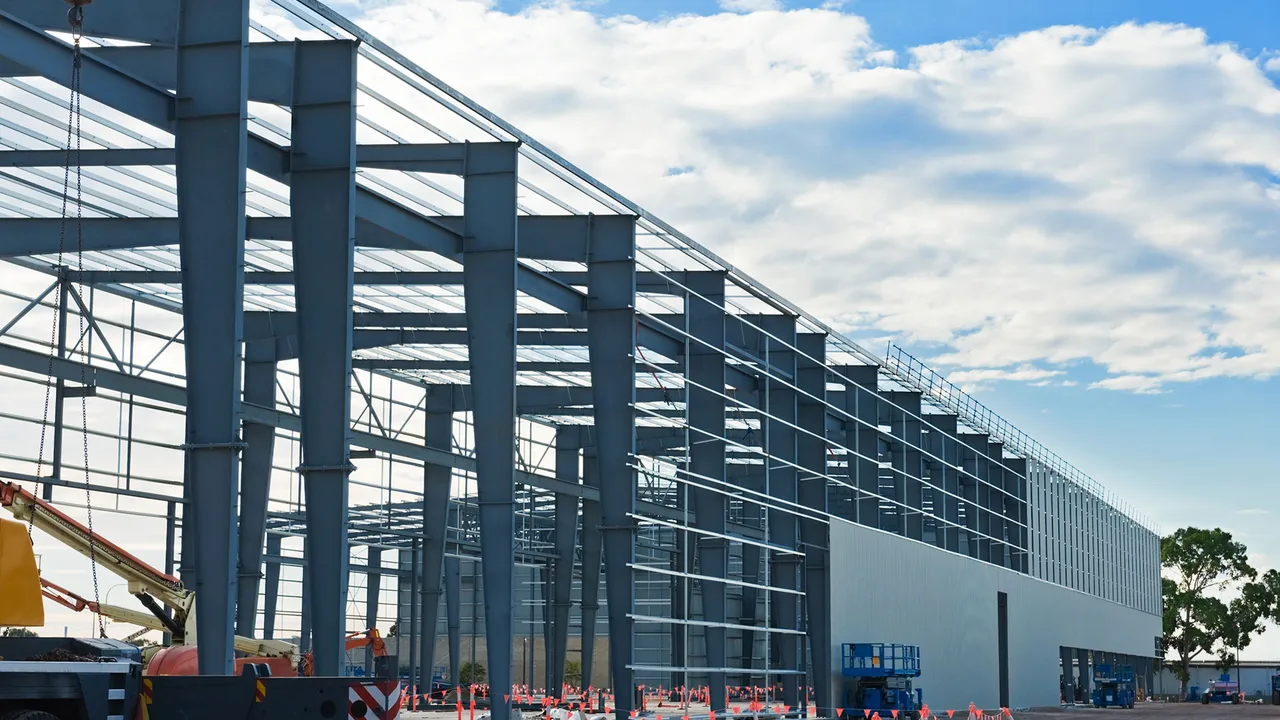
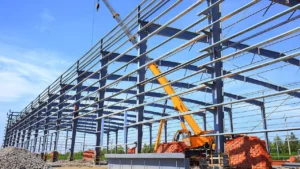
Factory bay spacing design refers to the planned distance between structural columns in an industrial building. These columns form a structural grid system that supports roof beams, crane systems, and secondary framing elements. Typical bay spacing in light industrial buildings ranges from 6 to 9 meters, while heavy industrial facilities may extend beyond 12 meters depending on span requirements.
At its core, bay spacing influences three structural variables:
- Structural span – the distance primary beams or trusses must cover.
- Load distribution – how weight transfers from roof and cranes to the foundation.
- Steel consumption – longer spans typically require heavier sections.
A shorter spacing means more columns but lighter beams. A longer spacing reduces column quantity but increases beam depth and weight. Finding the balance between these competing factors is central to efficient industrial design.
Span Economics: Balancing Columns and Steel Weight
One of the most important considerations in factory bay spacing design is span economics. Every additional meter of span increases bending moments in beams, requiring stronger and heavier steel members. However, reducing span too much increases the number of columns, which raises foundation costs and may interfere with workflow.
Let’s consider a simplified comparison:
| Span Option | Number of Columns | Steel Weight per m² | Foundation Cost Impact |
|---|---|---|---|
| 20m Span | Higher | Lower | Moderate |
| 25m Span | Medium | Moderate | Balanced |
| 30m Span | Lower | Higher | Higher per Column |
From a purely structural perspective, larger spans increase material cost. But operationally, fewer columns create open space that supports flexible equipment layout and smoother logistics. The ideal solution often lies in a middle ground—optimizing steel tonnage while maintaining operational efficiency.
Column Grid Planning and Structural Efficiency
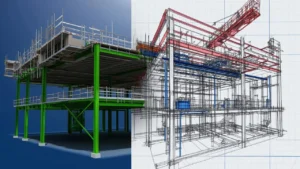
The column grid is the backbone of industrial structure planning. A well-designed grid ensures consistent load transfer and allows modular expansion. Common grid modules include 6m, 8m, 9m, and 12m intervals, selected based on building width, crane requirements, and roof system type.
In industrial factories equipped with overhead cranes, column alignment must match runway beam requirements. Misalignment increases structural complexity and fabrication costs. Therefore, factory bay spacing design must consider crane loads, lateral stability, and bracing systems from the earliest planning stage.
Structural efficiency also depends on how the grid interacts with mezzanine floors, service platforms, and roof purlin spacing. A consistent grid reduces fabrication variability and simplifies erection, resulting in faster construction timelines.
Equipment Layout: Designing Around Machines
Structure should serve production—not the other way around. One of the most common mistakes in industrial projects is selecting bay spacing based solely on structural optimization while ignoring equipment layout. Columns positioned without regard to machinery can obstruct conveyor lines, restrict forklift paths, or limit crane movement.
For example, a heavy fabrication facility operating long welding lines requires clear movement along the production axis. If columns interrupt that axis, production efficiency drops. Similarly, automated production lines often require uninterrupted linear zones where robotic arms and transport systems operate without obstruction.
When planning a steel structure factory, designers typically coordinate structural grid planning with machinery placement, assembly zones, and material staging areas. This integrated approach ensures that bay spacing supports real production requirements rather than simply minimizing steel tonnage.
Operational Flow and Internal Logistics
Beyond machinery, internal logistics heavily influence bay spacing decisions. Forklifts, automated guided vehicles (AGVs), and overhead cranes require predictable travel paths. Columns placed too closely together can create bottlenecks, especially in high-throughput facilities.
Consider the following operational factors:
- Raw material unloading and staging areas.
- Assembly lines requiring straight material flow.
- Finished goods storage zones.
- Safety clearance for heavy equipment movement.
Factories with optimized spacing often design “column-free corridors” along primary production paths. While this increases beam span and structural weight in certain areas, the operational gain frequently outweighs the incremental steel cost.
Foundation and Soil Considerations
Structural decisions cannot ignore geotechnical realities. Larger spans concentrate heavier loads on fewer columns, which means higher point loads on foundations. On soft soil, this may require deeper piles or reinforced footings, increasing project cost significantly.
Shorter bay spacing distributes loads across more columns, potentially reducing foundation depth but increasing excavation volume. Therefore, factory bay spacing design must integrate structural analysis with soil investigation data to find the most economical solution.
For sites with challenging soil conditions, sometimes a slightly shorter span reduces total project cost—even if steel consumption rises—because foundation savings offset material increases. This illustrates why bay spacing decisions should never be made in isolation.
Flexibility and Future Expansion Strategy
Industrial facilities rarely remain static. Production volumes increase, new product lines are introduced, and automation systems evolve. For this reason, factory bay spacing design should always consider long-term flexibility rather than only immediate construction cost.
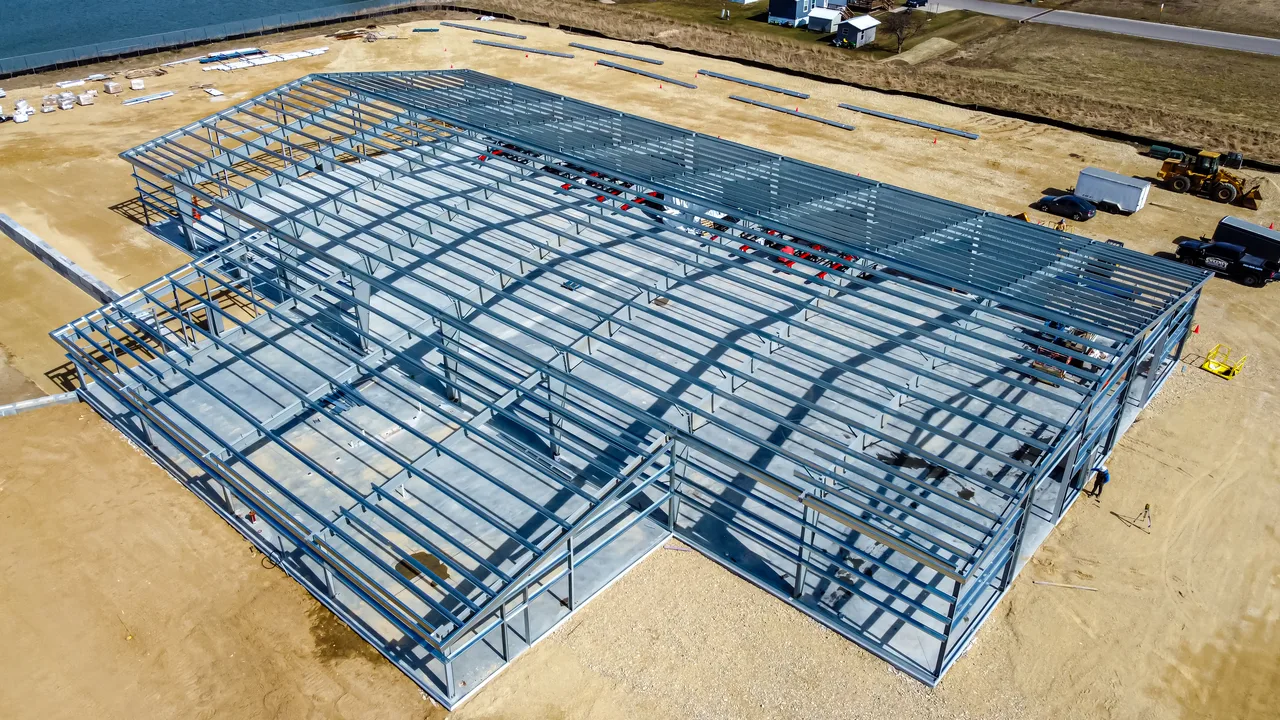
A well-planned column grid allows horizontal expansion without major structural disruption. For example, if the building is designed using modular grid spacing—such as consistent 8m or 9m intervals—future extensions can replicate the same structural rhythm. This simplifies engineering calculations, fabrication processes, and erection planning.
Longer spans may initially appear more expensive due to higher steel weight, but they often offer superior adaptability. Open interior zones make it easier to install new production lines, upgrade crane capacity, or reorganize internal departments. In industries with rapid technological change, flexibility can outweigh small differences in material cost.
When owners plan multi-phase development, the initial factory bay spacing design should align with a master expansion strategy. This prevents future retrofitting expenses caused by mismatched grid dimensions or incompatible structural systems.
Comparative Analysis: Light Factory vs Heavy Industrial Plant
Different types of factories require different bay spacing strategies. Light manufacturing facilities prioritize cost efficiency and moderate load capacity, while heavy industrial plants focus on large spans, crane systems, and high structural performance.
| Parameter | Light Factory | Heavy Industrial Plant |
|---|---|---|
| Typical Span | 18–24 meters | 24–36 meters |
| Column Grid Module | 6–8 meters | 8–12 meters |
| Crane Requirement | Optional | Essential |
| Structural Weight per m² | Moderate | High |
| Expansion Flexibility | Medium | High Priority |
In light factories such as packaging or assembly plants, tighter grid systems may be sufficient. However, in heavy steel fabrication or equipment manufacturing plants, larger spans are often necessary to accommodate crane travel paths and oversized components.
Common Mistakes in Factory Bay Spacing Design
Despite its importance, factory bay spacing design is often underestimated during early planning stages. Several recurring mistakes can compromise long-term efficiency:
- Focusing only on initial steel cost: Minimizing tonnage without considering workflow can lead to operational inefficiencies.
- Ignoring equipment layout: Columns placed without machinery coordination create bottlenecks and safety risks.
- Overlooking future expansion: A rigid grid system can make later expansion complex and expensive.
- Failing to integrate soil analysis: Foundation conditions significantly affect total project economics.
A comprehensive approach requires collaboration between structural engineers, production planners, and project owners. Early-stage coordination ensures that the grid layout supports both structural performance and business objectives.
Integrating Structure, Workflow, and Economics
Choosing the right bay spacing ultimately means balancing three major forces:
- Structural efficiency – optimizing steel weight and load transfer.
- Operational efficiency – ensuring smooth equipment layout and logistics.
- Economic feasibility – controlling total construction and foundation costs.
In practical terms, this means running comparative simulations. Engineers often evaluate multiple grid scenarios—such as 8m vs 9m column spacing or 24m vs 30m span—and calculate their impact on steel tonnage, foundation size, and erection time. The optimal solution is rarely the extreme on either side; instead, it is the configuration that achieves balance.
For example, increasing span by 3 meters may raise steel consumption by 8%, but if it eliminates an entire row of interior columns, production efficiency could improve by 15%. Over the building’s lifetime, the operational gain may far exceed the initial material increase.
Designing Beyond the Structure
Factory bay spacing design is not just a technical structural decision—it is a strategic planning choice that shapes productivity, cost control, and expansion potential. From span economics to column grid coordination and equipment layout integration, every meter of spacing influences how effectively a factory operates.
By analyzing structural loads, foundation conditions, operational flow, and long-term growth objectives together, decision-makers can choose a bay spacing configuration that supports both present efficiency and future adaptability. Factories designed with this holistic perspective tend to experience fewer operational disruptions, lower lifetime costs, and smoother expansion phases.
In industrial construction, success lies in alignment—aligning structure with workflow, cost with flexibility, and design with long-term vision. When bay spacing is chosen thoughtfully, the building becomes more than a structure; it becomes a platform for sustainable industrial growth.